The Rain in Spain reduces me to giggles still. Children have made it even funnier. Their mispronunciations and grammatical faux pas butcher the English language as much as Audrey Hepburn's put-on Cockney. True Cockney is as unintelligible as the Cajun coach on Waterboy, just pray you catch a few key words and are an apt student of body language. It's your only hope.
Eliza's "haitches" are particularly hopeless and horrendous. I love the etymological roots of our letter "H." Is it a vowel or a consonant? Haitch or aitch? I'll refrain from indulging myself in a grown-up Sesame Street sing along for today's letter of the day, though it might be fun. Is it an English major thing? A book worm thing? I get on a letter and brainstorm all of the words I like that begin with it. Much like after reading Shakespeare, I have to check myself to keep from speaking in iambic pentameter. Unless you need good wording for a child's birthday party, that shit's just annoying. The patterns or words fascinate me--the rises and falls, the harmony and dissonance.
As I start working on revising my blog's look and purpose, I thought about why I named it Mississippi Hippie Mama. Am I really a hippie? What on earth is a Mississippi hippie? Why even keep Mississippi in the title? I haven't lived there in almost ten years.
Mississippi is in me. You can't beat it out of me. It's not going to gradually wear away with time. It's just there. It's a poor and proud little state. It gets torn down by natural disasters and it's own internal turmoil and politics, but it hops right back up. It's a brave and giving state. It's got the best music in the world, the best food, the best people. Have you ever thought of all of the talent that comes out of Mississippi--the musicians, the writers, the actors, the artists?
Mississippi stays. Faulkner nailed it when he said, "To understand the world, you must first understand a place like Mississippi." I cannot define myself or tell my story without Mississippi in all it's complexity.
I probably would have enjoyed some of the philosophies, people, and parties of San Francisco's Haight-Ashbury in the 60's, but I would have enjoyed the new Pucci boutique on the designer row as well. That's a big part of why I say Mississippi hippie. Every place we have lived, people ask where I'm originally from. "Oh, you're a Jackson girl," they say like that explains it all. What on earth? Are we that distinct? I don't wear heels and makeup every single day anymore. Does the Jackson cultural equivalent of Eliza's diphthong deficiency still linger? Apparently so.
Yes, I like yoga, wear busted Birkenstocks, diffuse essential oils, ferment things on my granite countertops, breastfeed indefinitely, embrace informed decision making, forgo sunscreen for that vitamin D, sew clothes for my kids, hoard mason jars, have babies at home, use coconut oil for everything (yes, everything), cosleep, think GMOs are the great satan, and idealize "intentional living communities." I also love red lipstick, designer denim, a good party, the internet, setting a pretty table, vampire novels, beer, Clorox, Miss Manners, angry rock and roll for running, interior design, monogrammed stationery, finger sandwiches, and codeine cough syrup when all else fails.
It's like wearing amber with pearls or a diamond drop, both of which I've done. I'm not picking. The H stays. In fact, I don't love the word hippie. It's kind of silly, maybe even a pejorative depending on who drops it as a word bomb. Lots of other H's fit:
Healthy, holistic, happy, helpful, homemade, happy-go-lucky, honest, hausfrau, and harmony-craving.
I am also harsh, half-cocked, hurried, hormonal, hard-headed, hasty, and maybe a dash heretical.
Most of all I'm human. If you can't find a seemingly irreconcilable difference within your predilections or preachings, dig a little deeper. You are one of two things--a liar or a bore. There is no neat, simple solution. I'm both, two things diametrically opposed--southern traditionalist and non-conforming free-spirit. Instead of, "If you can't say anything nice, come sit by me," my motto should be, "If you can't quite fit in, come sit by me." I usually find a way to blend the overlapping edges just like a good eyeshadow application, shifting between circles like the outfit that can go from day to night out with a change of shoes.
Don't cram yourself into one teeny, limiting box. That's just no fun. Be complicated, be controversial, be genuine.
Showing posts with label breastfeeding. Show all posts
Showing posts with label breastfeeding. Show all posts
Tuesday, July 22, 2014


Thursday, October 3, 2013
The Dance
So often the metaphor of a dance is used to describe breastfeeding. It calls to mind ballroom dancers sweeping across a polished floor dressed to the nines and moving like one. Of course there were sweet, irreplaceable moments of cuddling my newborns as they head bobbed, smacked their lips, licked their hands, and slowly unfolded to make their way to my breast. There were also moments when their initial attempt to latch made my toes curl and called for a pinkie gently inserted into the corner of their precious little mouths to break suction and try again. Let's just say that learning to nurse my babies was a far cry from fluid perfection. With the moments of oxytocin and prolactin-laced bliss were also tears, frustration, and some bleeding nipples. Had I known then what I know now, I would have asked for more help and really stayed vigilant those first few days ensuring that our latch was both comfortable an effective.
Apparently, I am a milk maker with IV fluids and without. I was admitted and receiving antibiotics at least intermittently for at least 24 hours before Isabelle was born. My milk came in about 36 hours after she was born. The nurse didn't believe me when I said I was engorged. My breasts were so hard and nipples so flat that Isabelle could not latch onto them. I wanted to pump (again had I known that hand expressing and reverse pressure softening worked better...). She brought it to me with a teeny beaker and a mildly annoyed look--"This is her first baby. What does she know?" Quite a bit actually. In about a minute and a half, that little beaker was overflowing. I'm not sure if milk running all over or her look of shock were funnier. Yep, most of us know when our boobs feel like they're going to pop. It wasn't the fluids or a poor latch that caused my engorgement. It happened with Will. Boom, milk in 24 to 36 hours. He was born at home. Zero fluids necessary that time, though my midwives carried them in case of dehydration.
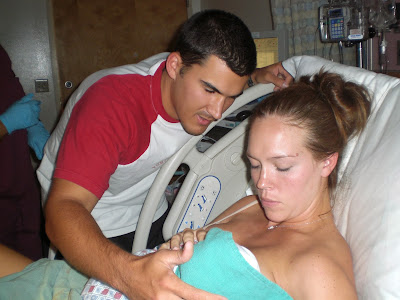
Yes, abundant milk is a blessing, but it's also a challenge. I experienced extreme engorgement despite frequent feedings on demand. It shot across the room, soaked the sheets, made dispisable nursing pads an inch thick like a sodden diaper. I learned a lot after the first time with this challenge. For round two, I used reverse pressure softening, block feeding, and ice, not heat as my breasts were literally warm to the touch and super sore.
Is this sounding like Dancing with the Stars? I am getting back to the dancing part. Suffice it to say that all of this milk was spraying like an opened fire hydrant as soon as I was free of whatever held a pad to my leaky breast and had baby in the general vicinity. This made me get lazy about latching from time to time. The forceful flow also made my baby not want to latch deeply. Put those two things together, and you've got some sore nipples. Even a handfull of lazy, not so comfy latches can make you really sore really quickly.
It's a bit damning to hear about this "dance" when dancing is a) something you don't enjoy b) are not good at c) that if anyone sees you doing you should have been cut off from the bar and driven home at least an hour earlier. Maybe that's just how I feel about dancing. We are all different, but most of us had to practice and get some basic skills before busting that move with confidence. So, just as you must learn the basic steps before you dance, maybe even work to screw up the courage to even try, you have some basic steps to learn breastfeeding a newborn as well. It can't hurt to dig up a little courage either. Much like dancing, breastfeeding can be a very instinctive, natural thing for some mothers and babies. For most of us, though, there is a bit of a learning curve. Here are a few tips that helped me:
I loved, loved, loved nursing my babies. Even in the early days when it did hurt some, I did not want to stop. I definitely needed some more help and patience. I'm one to muscle through when something is hard and admit it was hard afterwards. It wasn't something I "stuck with" to prove anything to myself or anyone else. It was simply what was right for my family and me.
The nursing relationship you have with your child is unique--there are silly dancers, svelte ones, ones so relaxed that they don't even care about the music, uptight ones who have to try hard, stop-start ones who step on toes occasionally, ones that might need a few professional lessons, ones that move like the music is part of them. To learn this dancing stuff, some watch videos, read books, watch others do it, do it instinctively, or figure it out by trial and error. As long as you leave the dance floor with a smile and a feeling of satisfaction, you've done it correctly.
Apparently, I am a milk maker with IV fluids and without. I was admitted and receiving antibiotics at least intermittently for at least 24 hours before Isabelle was born. My milk came in about 36 hours after she was born. The nurse didn't believe me when I said I was engorged. My breasts were so hard and nipples so flat that Isabelle could not latch onto them. I wanted to pump (again had I known that hand expressing and reverse pressure softening worked better...). She brought it to me with a teeny beaker and a mildly annoyed look--"This is her first baby. What does she know?" Quite a bit actually. In about a minute and a half, that little beaker was overflowing. I'm not sure if milk running all over or her look of shock were funnier. Yep, most of us know when our boobs feel like they're going to pop. It wasn't the fluids or a poor latch that caused my engorgement. It happened with Will. Boom, milk in 24 to 36 hours. He was born at home. Zero fluids necessary that time, though my midwives carried them in case of dehydration.
 |
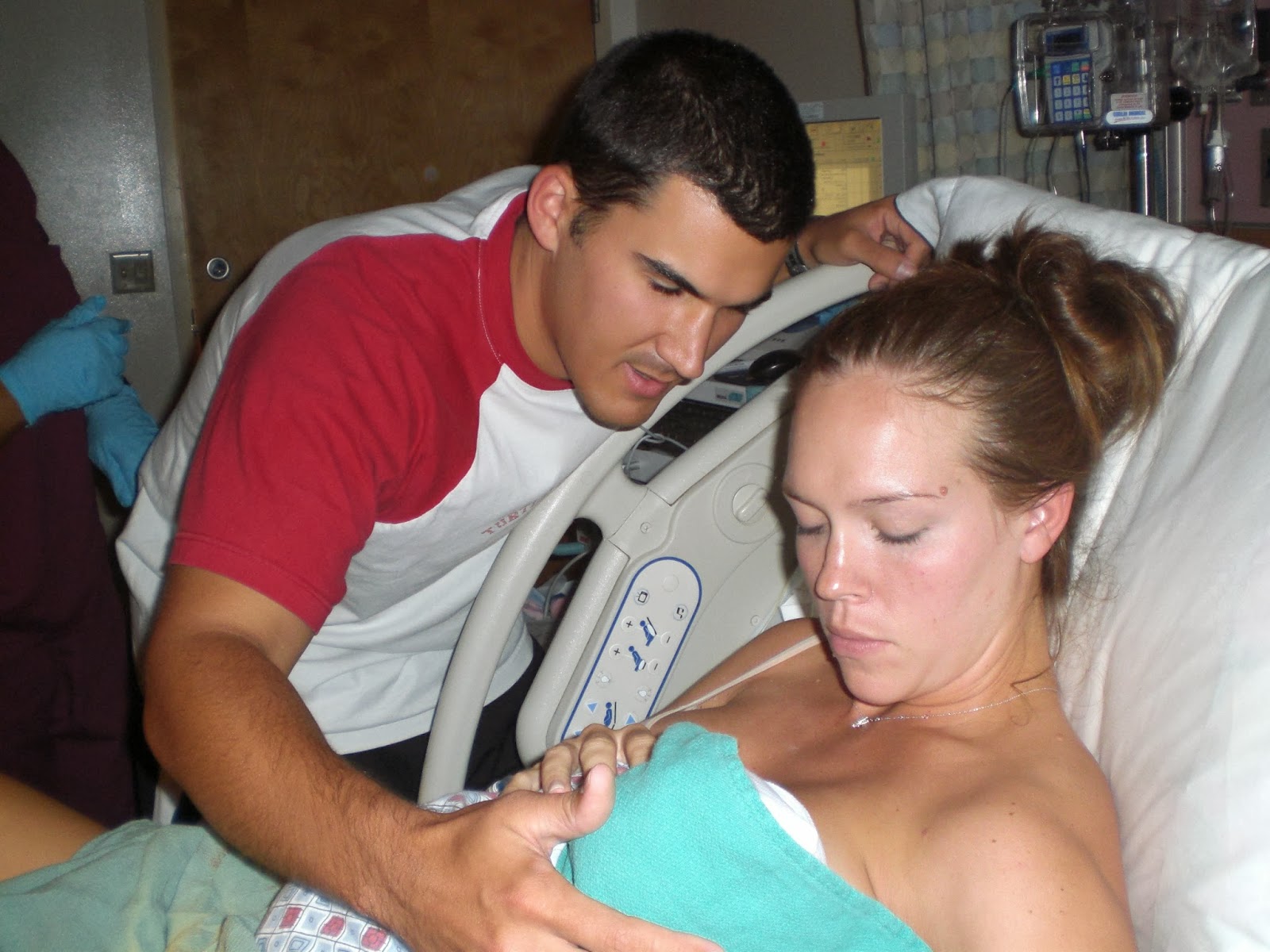
| Pretty good latch. Could be more asymmetrical and not so centered on my nipple. This one was okay-comfortable. Not great, but no toes curling. See how intensely focused he is? All instinct. He is super new here. I think this was actually before the above family pic. He pinked up quickly. |
Is this sounding like Dancing with the Stars? I am getting back to the dancing part. Suffice it to say that all of this milk was spraying like an opened fire hydrant as soon as I was free of whatever held a pad to my leaky breast and had baby in the general vicinity. This made me get lazy about latching from time to time. The forceful flow also made my baby not want to latch deeply. Put those two things together, and you've got some sore nipples. Even a handfull of lazy, not so comfy latches can make you really sore really quickly.
It's a bit damning to hear about this "dance" when dancing is a) something you don't enjoy b) are not good at c) that if anyone sees you doing you should have been cut off from the bar and driven home at least an hour earlier. Maybe that's just how I feel about dancing. We are all different, but most of us had to practice and get some basic skills before busting that move with confidence. So, just as you must learn the basic steps before you dance, maybe even work to screw up the courage to even try, you have some basic steps to learn breastfeeding a newborn as well. It can't hurt to dig up a little courage either. Much like dancing, breastfeeding can be a very instinctive, natural thing for some mothers and babies. For most of us, though, there is a bit of a learning curve. Here are a few tips that helped me:
- Room-in. A healthy baby should go straight to your belly or chest after birth and not leave your room. Sorry to disappoint the family, but playing pass the baby is out. It's my least favorite game ever. They have years and years to enjoy the kid. You only get the golden hour and those early days learning to breastfeed once. A lot of damage is done unwittingly by those who love and want to help you most. You and your baby are still parts of a whole. Your body is your baby's natural habitat.
- Do not hurry baby to the breast. All of what may appear to be "messing around" is actually how your baby prepares to breastfeed for the first time..
- Let baby practice latching and be patient. Some latch right away, some take a while. It depends on your birth and your baby. Medication you have in labor does cross the placenta and reach the baby very quickly. This may or may not affect your first few hours or days of feeding.
- In any position, baby's ears, shoulders, and hips should be in a straight line. Can you drink from a cup with your head turned?
- Delay baby's first bath at least 24 hours.
- In the early days and weeks, your body is setting prolactin receptors that determine how much milk you will EVER produce for that child. It resets for each baby. Nursing very often = healthy supply down the road.
- Strip your baby to a diaper for feeding. Better yet, keep them naked but for that diaper and skin-to-skin as much as possible.
- Keep the lights dim and the room calm and quiet.
- No hats or mittens as these can inhibit some of the twenty-something newborn reflexes that are all about learning to breastfeed.
- No pacifiers, bottles, breast shield, or anything else plastic and nipple shaped you might run across. Nothing but your breast and the occasional clean finger ever need enter baby's mouth.
- No burrito babies. Tightly swaddling baby does make them sleep better. When they were inside you, they were tightly held. They also had a constant source of food that nourished them whether awake or asleep. You need your baby to wake and feed. Swaddling can cause them to sleep through early hunger cues and wake up the distraught kind of hungry. It can be very challenging to soothe and latch a newborn who is this hungry.
- Feed in gravity-friendly laid-back positions that allow baby to self-attach. I know, you've read books on breastfeeding, and the kid was born yesterday. Let it go. Your newborn really probably does know more about breastfeeding than you.
- Wear soft, unstructured nursing bras or tanks. No underwire as it can lead to blocked ducts. No sports bras as compression decreases supply.
- Set mini-goals. Don't start out saying you'll breastfeed for 6 months, a year, two years, or beyond. Make it through the first day with baby on the breast only then the first few days, the first week, the first two weeks, etc.... You are more likely to stay on track for your bigger goal if you break it into teeny ones.
- A latch that looks perfect but hurts is not perfect. It may not look textbook perfect. If it feels good, and baby is transferring milk well, roll with it. You'll know they are transferring well the first few days by dirty and wet diapers. After that, you'll see and hear them swallowing actively while feeding.
- No shushing the baby. This goes along with my hatred of pass-the-baby and extends well into infancy. A newborn who is crying needs his or her mother's breast either for comfort or nutrition.
- Feed on demand, that is, your baby's demand. Do not limit feeds, delay feeds, or feed on a schedule. Doing so will harm your milk supply. Your baby's cue's are your schedule.
- A soft carrier like a ring sling or wrap, either jersey or woven at first, can really help with that demand feeding, constant contact thing. Human babies need to be close to their mothers around the clock for the first few weeks even months. Carrying them this way enables you to have two free hands and meet your baby's needs.
- Crying is the final hunger cue. Your baby should be at the breast before he or she is crying. Watch for looking around, opening and closing their mouth, licking and smacking, big body movements, hands/fingers to the mouth, and the tell-tale head bob. If they are upright and front-to-front with anybody, they'll bob around looking for a nipple. Strong instincts much?
- Frequent feedings are NOT a sign of you not making enough. The typical newborn should feed at least 10-12 times every 24 hours. Your baby's stomach does not even stretch until day 3. Diapers tell more than any stupid clock.
- Don't try to memorize everything that could possibly go wrong and constantly scan for problems. Learn what's normal and what needs attention and who to call if something needs attention.
- Don't pump in the early days and weeks unless your baby is unable to latch effectively and you need the stimulation to keep your supply. It's likely going to prolong engorgement and oversupply. If you're going back to work, wait until a week or so before. Hand express to comfort only. If you take it out, your body will put it back. Yes, it can be uncomfortable to feel full, but it signals your body to produce just what baby needs.
- Rest and set boundaries with family and friends who want to visit. You must take good care of yourself before you can take care of anyone else. Spend 5 days in bed, 5 days on the bed, and 5 days near the bed to let yourself heal and get off to a good start breastfeeding. Let the people around you take care of you, your house, and your family. You need to rest and be comfortable feeding your baby, not entertain a slew of people every day.
- Get a good breastfeeding book before baby is born. One that can be used as a reference book such as The Womanly Art of Breastfeeding or The Nursing Mother's Companion is ideal.
- Write the names of several people who you can go to for help inside the cover of this book. Agree with your spouse, partner, family, whatever that if you are in a bad spot and won't call them yourself, they can reach out to these people for help and support.
- Donate formula samples to your church or a women's shelter. You do not need it "just in case." There will be a challenging day or night and somebody who loves you will be tempted to give "just a little" to either give you a break, let your sleep, lighten your load, etc. A bottle or two in the early days/weeks really can undermine you.
- Read up on physiologic jaundice. A lot of pediatricians do not know squat about breastfeeding and will tell you that you "have" to supplement with formula to push the bilirubin through. In extreme cases, maybe, but not usually. Bilirubin breaks down as your baby metabolizes food, so breastfeed often and do compressions to get as much milk into baby as possible. Natural sunshine on bare skin helps as well. Obviously, don't sunburn or freeze your baby.
- Research birth control carefully. Many options offered do frequently decrease milk supply. That's further down the road, but it never hurts to look ahead!
- If in doubt or just having a tough day, ask for help. Sometimes a hug from a friend who's been there and a kind word are all you really need. Your midwife, a postpartum doula, La Leche League Leader, or lactation consultant can help if you need more than encouragement. It's usually best not to ask your OB or pediatrician for breastfeeding help as they receive minimum (if any!) training in human lactation.
I loved, loved, loved nursing my babies. Even in the early days when it did hurt some, I did not want to stop. I definitely needed some more help and patience. I'm one to muscle through when something is hard and admit it was hard afterwards. It wasn't something I "stuck with" to prove anything to myself or anyone else. It was simply what was right for my family and me.
The nursing relationship you have with your child is unique--there are silly dancers, svelte ones, ones so relaxed that they don't even care about the music, uptight ones who have to try hard, stop-start ones who step on toes occasionally, ones that might need a few professional lessons, ones that move like the music is part of them. To learn this dancing stuff, some watch videos, read books, watch others do it, do it instinctively, or figure it out by trial and error. As long as you leave the dance floor with a smile and a feeling of satisfaction, you've done it correctly.
.jpg) | |
| Isabelle maybe 2-3 minutes after birth. She was practically born wearing that hat. We look so young and exhausted! Sleep? Oh, you'll see that old friend in a few years. |
 |
| Big, open mouth. See the wrinkle under her little chin. There's one of those hands. I cannot imagine trying to nurse a swaddled baby. There is something so sweet about their new, wiggly self squirming against you. |
 | ||
| Will maybe 10-15 minutes after birth. No hat. Same spot between my breasts. If you give a mother her baby, this is where almost all will instinctively place the baby. I'd already birthed the placenta here. Mine come pretty soon after the baby. |
 |
| Not such a good one. Maybe because I'm blocking his little hand, and numbing his instincts. He even looks frustrated. He needs to be lower. Mouth wasn't open widely enough to get lots of breast in his mouth that try. See, it's trial and error. They latch well, suck a while, pop off, and relatch not so well often. Patience. |
 |
| Look at that, let the hand roam free, and get a better latch. All pink, even the hands. Extremities are the last things to get nice and pink after birth. |


Sunday, July 8, 2012
Everyday Advocacy
How I'm meeting one of those first resolutions, the one about doing more in my community for mothers and new babies--a recent letter sent to a local hospital:
I recently learned that the lactation program at Singing
River Hospital in Ocean Springs was eliminated.
I am extremely concerned about the ways in which this will reduce the
quality of care for new mothers at your hospital. This is a worthwhile program. Every hospital that provides services for
birthing women needs a highly-trained and experienced lactation staff. Almost all new mothers plan to breastfeed,
but very few make it to their own goals.
A recent study published cites unnecessary supplementation in the
hospital as the number one undermining factor.
I do understand that our current economy necessitates tight
budgeting and review of all programs for improvement and efficiency. There are several easy, mostly free ways to
decrease costs in the LDRP programs. As
you will see on this mPINC
survey, the CDC agrees with my suggestions.
Healthy newborns should be placed skin-to-skin with their
mothers immediately. All routine newborn
procedures may be performed this way easily.
All babies, even those born by cesarean should be nursing within the
first hour of life. The neonate’s
instinct to root and suckle are strongest in that first hour to two, so
delaying skin-to-skin contact results in a missed window of ideal breastfeeding
initiation. A baby who is given formula, or artificial breastmilk substitutes
according to UNICEF and WHO, or glucose water is likely to have a harder time
latching appropriately to the breast to express its own mother’s milk.
In Memphis, TN and Jacksonville, FL where I have lived
previously, mothers who give birth by cesarean are offered lactation support in
recovery and never separated from their babies.
I have not seen or heard of this anywhere in the state of
Mississippi. Immediate skin-to-skin and
unlimited access to nursing on demand are the standard of care in states whose
overall healthcare outcomes far exceed our own.
Well-baby nurseries are unnecessary, undermine breastfeeding,
and require costly additional staffing.
Healthy mothers and babies should room-in. As the mPINC survey shows, 0% of MS hospitals
report healthy newborns being with their mothers for 23+ hours a day. This is shocking and upsetting to me. I was not ever separated from either of my
two children, both of whom are extraordinarily healthy and breastfeed well over
their first year of life. The hospital
at which my first child was born did not even have a well-baby nursery. Their staff truly supported breastfeeding.
The “transition” period should be an in-room service. Science consistently confirms that neonates,
even preterm babies, regulate both breathing and temperature best when placed
skin-to-skin with their mothers. In
addition, they are first colonized by bacteria from their mother’s skin rather
than what happens to be floating about the newborn nursery. Namely,
they thrive while infants routinely separated from their mothers
experience greatly increased stress. There is no reason for healthy
babies to be
separated from their mothers for up to 4 hours.
In fact, research supports eliminating routine separation of healthy
mothers and babies as the ideal way in which to support the mother-baby dyad.
Staff should be truly trained in lactation support. Nursing school does not provide adequate
training, nor does any program sponsored by a formula company. We are so close to New Orleans, where the annual
Gold Standard
conference convenes and literally world-renown breastfeeding experts share
their knowledge and experience in teaching workshops. Key staff should attend that conference. Several groups offer breastfeeding specialty
workshops designed for nurses. There is no
excuse for hospital staff not to be better trained to support the needs of
their mothers and babies.
These changes and strides towards evidence-based care would
drastically impact the number of mother and babies who enjoyed the often hoped
for exclusive breastfeeding relationship.
It would, thereby, positively impact the patients of your hospital and
families in our community both in terms of physical and emotional health.
I am very concerned at the lack of breastfeeding knowledge
and support within the hospitals of the Mississippi Gulf Coast and our great
state at large. I am committed to
serving the women around me through support and education, but I cannot do it
alone. Eliminating lactation at your
hospital is a step backwards. I would be
so proud if any of the Singing River hospitals began to implement the
UNICEF/WHO Baby
Friendly Hospital Initiative.
Mothers in our area would absolutely change care providers willingly to
receive care at an officially designated baby-friendly hospital.
Thank you for your time, and I look forward to hearing back
from you and working together to enact positive change. I am happy to schedule a meeting to
brainstorm ideas on this subject or provide you with additional resources and
research. Also, if it would be best to contact another individual in regards to this problem, please let me know.
Sincerely,
Kate
Fillingim, LCCE
Additional
resources for your perusal:
Subscribe to:
Comments (Atom)